

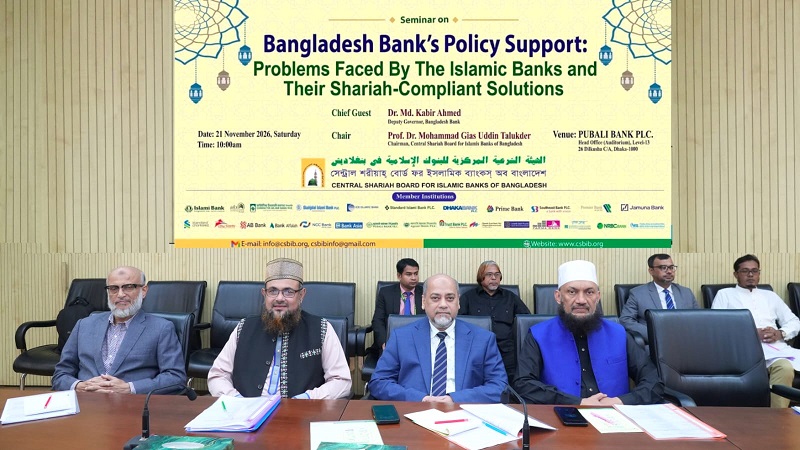
Seminar on “Bangladesh Bank’s Policy Support: Problems Faced By The Islamic Banks and Their Shariah-Compliant Solutions” Held
A seminar titled “Bangladesh Bank’s Policy Support: Problems Faced By The Islamic Banks and Their Shariah-Compliant Solutions”, organised by the Central Shariah Board for Islamic Banks of Bangladesh (CSBIB), was held on Saturday, 21 November 2026, at the Auditorium of Pubali Bank PLC Head Office, 26 Dilkusha C/A, Dhaka.
Presided over by Professor Dr. Mohammad Gias Uddin Talukder, Chairman of the Central Shariah Board, the seminar was attended by Badiur Rahman, Chairman of the Board of Directors of Al-Arafah Islami Bank PLC as guest. Principal Dr. Md. Anwar Hosain Molla, Vice-Chairman of the Central Shariah Board, delivered the welcome address.
The keynote paper was presented by Mohammad Shamsuddoha, Head of Shariah Secretariat Wing & SEVP of Islami Bank Bangladesh PLC; Dr. Mufti Yousuf Sultan, Member of the Shariah Advisory Board of Bangladesh Bank; and A.K.M. Mizanur Rahman, Deputy Chief of Islamic Banking & SEVP of Eastern Bank PLC. The paper observed that Bangladesh Bank’s policy support measures, such as rescheduling, restructuring, refinancing, pre-financing and special exit facilities, have been designed primarily around the conventional banking framework, and Islamic banks are therefore often unable to implement them.
Charging profit during the grace period and unilaterally waiving profit from the funds of Mudarabah depositors were cited as examples. As solutions, the paper proposed a separate circular for Islamic banks, refinancing funds based on Wakalah, Mudarabah and Musharakah, Shariah-compliant liquidity support for provisioning against non-performing investments (NPI), and recovery of NPIs through Ju’alah- and Ibra’-based settlements. The paper argued that, rather than special privileges for Islamic banks, an equitable Shariah-compliant regulatory framework that recognises their contractual differences would be more reasonable.
The panel discussion featured Professor Dr. Mohammad Omar Farooq, Chairman, Department of Economics, United International University; Professor Dr. Zubair Mohammad Ehsanul Hoque, Chairman of the Shariah Supervisory Committee of Sonali Bank PLC & Professor, Department of Arabic, University of Dhaka; Mohammad Ali, Managing Director and CEO of Pubali Bank PLC; Mawlana Shah Mohammad Wali Ullah, Member of the Shariah Advisory Board of Bangladesh Bank; Md. Siddiqur Rahman, Additional Managing Director of Standard Islami Bank PLC; and Mohammad Anisur Rahman, Director, Islami Banking Regulations and Policy Department (IBRPD), Bangladesh Bank.
The discussants noted that, as the contractual structure of Islamic banking differs from conventional lending, the fundamental principles of Shariah must be taken into account in setting the terms and procedures of policy support. They stressed the need to balance leniency towards genuinely affected clients with a firm stance against wilful defaulters. In the views-exchange session that followed, participants raised various questions and shared their views.
Speaking as the Guest, Badiur Rahman, said that, alongside ensuring good governance and accountability, practical, Shariah-compliant policy support is needed to restore the financial stability of Islamic banks and depositors’ confidence.
In his presidential address, Professor Dr. Mohammad Gias Uddin Talukder said that a coordinated initiative of Bangladesh Bank, Islamic banks and Shariah Supervisory Committees is essential to secure the benefits of policy support while maintaining Shariah compliance.
The seminar concluded with a vote of thanks and Du’a conducted by Principal Dr. Md. Anwar Hosain Molla, Vice-Chairman of the Central Shariah Board.
Senior executives and officials of Bangladesh Bank, representatives of the Bangladesh Securities and Exchange Commission and Bangladesh Institute of Bank Management, top executives of banks providing Islamic banking services, members of Shariah Supervisory Committees, academics, researchers and leaders of the CSB Fellows Forum—over 200 participants from 42 institutions in all—attended the seminar.